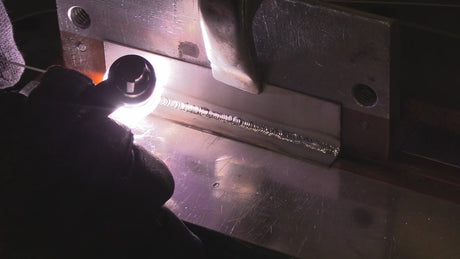
A TIG settings charts gives guidelines, not rigid rules

A tig welding settings chart can be very helpful for certain things (like getting you in the ball park on amperage) especially if you are just learning tig welding.
But settings like AC balance, AC frequency, and pulse settings are often a matter of preference and also can differ from machine to machine.
There is no substitute for putting in the time to fully understand the settings of your tig welder.

Why charts help — but experience still matters
A tig welding settings chart can serve as a quick reference to make sure you things set up properly for things like polarity, pre and post flow, etc.
But machines are all different on how the knobs and buttons function so referring to the owners manual is the first thing you want to do.
Core Factors That Affect Settings
- Material type and thickness -
Generally speaking, the thicker the metal, the more amperage needed. Material type also makes a difference.
Aluminum requires more amperage than carbon steel and Carbon steel requires more amperage than stainless.
Aluminum and magnesium are both welded using AC.
Almost everything else is welded using DCEN. (Carbon steel, stainless, nickel alloys, titanium and more)
DCEP is almost never used for TIG welding.
- Joint type (corner, lap, edge, butt, tee)
The type of joint can also determine amperage and settings.
For example a tee joint will need more amperage than an outside corner joint.
- Position (flat vs out of position)
Since flat position welds are more comfortable, travel speed can often be faster than out of position welds like vertical. Vertical welds often go slower and so less amperage is often used.
- Machine type (inverter vs transformer)
Newer inverter tig machines have many settings that can be used to optimize practically any weld and any material. But only if you understand the settings and the fundamentals behind them.
For example, AC frequency setting can be used to constrict the AC arc for certain situations. It can also be used to get more heat input on thicker aluminum.
Amperage Basics
- “1 amp per thousandth” rule — where it works and where it breaks down.
The “1 amp per thousandth” rule basically means that carbon steel .100” thick needs roughly 100 amps. This holds true up to around 125 thousandths but as you get thicker, the rule starts to break down.
A foot pedal or torch mounted amp control can help you make adjustments on the fly for thick vs thin material and for different types of metals. I prefer a foot pedal but there are lots of jobs where a torch mounted amp control offers more freedom of movement. For example a chromoly fuselage made from 4130 tubing can be a royal pain in the butt dragging a foot pedal all around.
Foot pedal vs finger amp control, vs button, vs lift arc, vs scratch start considerations
TIG welding offers lots of options when it come to amperage control and it depends on what you are doing as to which one is best.
There are foot pedals, wireless foot pedals, different styles of finger controls, and on/off buttons and switches.
A lot of newer tig machines also have 2t 4t functions along with upslope and downslope settings that can be used along with a button or torch switch to provide some amperage control at the start and end of a weld.
Tungsten Selection
- Diameter vs amperage capacity
Tungsten electrodes have an amperage range just like stick electrodes.
Higher amperage requires a larger diameter electrode.
If you exceed the upper limit, the tip of the electrode will often dump into your weld and that’s a problem.
Most tungsten amperage charts are a bit generous when it comes to maximum amperage…especially for the smaller diameter electrodes.
The chart below lists a safer and more realistic upper amperage limit.

Why risk dumping tungsten in your weld when it only takes a minute to switch to a larger tungsten?
Tungsten Choices
Your choice of type of tungsten depends on what you weld most.
For example, I talked with a couple of guys who build custom motorcycles who mostly weld carbon steel and chromoly but also occasionally weld thin aluminum. They preferred 2% ceriated tungsten due to it staying sharp longer on DCEN while also being good for thin aluminum.
I know another guy who mostly welds aluminum between .090” and .125” thick but also occasionally welds stainless and carbon steel. He prefers LaYZr from CK worldwide because it maintains tip shape at medium amperage on aluminum and also works well on DCEN.
Personally, I use 2% lanthanated for everything because I make welding videos and weld a mix of carbon ,stainless, and aluminum.

Gas Flow & Cup Size
- How cup size actually affects CFH
Most online resources recommend 15-20 CFH for tig welding. I think a better way to think is 2 to 3 CFH per cup size. Cups are sized according to 16ths of an inch so a #10 cup would require 20-30 CFH and a #5 cup would require 10-15 CFH. To me this makes way more sense than simply stating 15-20 CFH as if that works for every cup size. Especially now that we have furick cups and flood cups available.
Gas lens vs standard collet body
There are times when a gas lens makes a big difference and there are times when a standard collet body is the way to go.
Dirty material like galvanized, or a dirty casting will sometimes spit, outgas and deposit on the diffuser of a gas lens. In those situations a standard collet body might be the best choice.
A lot of welders prefer a standard #5 cup with collet body for aluminum tig welding. But there are also plenty of really good tig welders who prefer a gas lens.
A #6 gas lens is a good all around cup for tig welding aluminum
Tuning your gas flow to the cup you are using is more important than whether you use a collet body or gas lens setup when welding aluminum.
Argon gas flow rates on aluminum affect the cleaning path so it pays to tune the gas flow to the cup while also paying attention to the AC balance setting.
- A Common mistake: too much gas flow
Too much gas flow for tig welding aluminum can cause a very noisy and erratic arc.
Too little gas flow limits cleaning action and can cause oxides aka pepper in the puddle.
For carbon steel, too much gas flow can cause a turbulent flow that draws air into the argon causing porosity.
Quick Reference TIG settings
- Carbon steel DCEN 1 amp per thousandths Jazzy 10 ceramic 20-30 CFH
- Stainless steel DCEN 0.8 amp per thousandths Furick 12 ceramic 24-36 CFH
- Aluminum AC 1.2 amps per thousandths #6 gas lens with 12-18 CFH AC frequency 100hz AC balance 31% cleaning