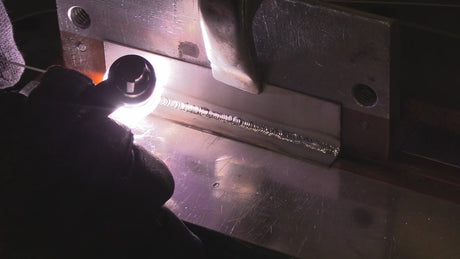
Now let's talk about stainless steels....300 series
There are many different grades of stainless but the most common one is 304L.
after that 303, 316, 321 are also common depending on the industry we are talking about.

You can find 304 stainless in breweries, power plants, swimming pool ladders, etc.
304 is one of the most common stainless steels and it is usually welded using 308L filler metal.
Sometimes its welded without filler metal ( that is called autogenous welding) and other times its welded using er308L filler . The L stands for low carbon
The carbon content is kept low to prevent carbide precipitation during the heat cycles of welding.
What happens if you heat up a piece of 304L stainless until its red hot and then dunk it in ice water?
Not much.
It will not harden like carbon steel will.
That is because 304L has lots of chromium and nickel and the nickel prevents hardening.
304 is what is known as an 18/8 stainless with roughly 18% chromium and 8% nickel.
while the chromium and nickel make it corrosion resistant, they prevent hardening from heating and cooling.
A common myth in welding is that you shouldn’t speed cool any metal ever.
Not true with stainless.
In fact, speed cooling with forced air can be a good thing to prevent overheating in between weld passes.
The main way heat from welding affects stainless if that if stainless steel is held at too high a temp for too long, it can lose its corrosion resistant properties.
Something called "carbide precipitation" can happen in stainless when it is held a too high a temperature (700 °F to 1500 °F) for too long.
What happens is that chromium particles and carbon particles migrate towards each other and combine to form chromium carbides.
This leaves certain areas in a chromium depleted state and these areas lose their corrosion resistance.
This usually happens at grain boundaries.
This carbide precipitation then causes something called intergranular corrosion...
And that causes stress corrosion cracking (SCC)
All this does not necessarily mean that low amperage should be used.
In fact, sometimes higher amperage and faster travel speeds are the ticket.
Travel speed has a big affect on heat input , but so does chill factor.
Using techniques that don't keep the stainless too hot for too long help.
Pulse tig settings, chill bars, and a fast travel speed can all be very helpful in maintaining the stainless properties of stainless steels.
One more thing about Stainless Steels.
A condition known as granulation aka "sugaring" can happen on full penetration stainless welds unless purge gas is used.
Sugaring is NOT the same thing as carbide precipitation.
Sugaring ia technically called granulation and can be mitigated by using copper or aluminum backing but an argon purge is usually best practice
Sugaring can be avoided by purging the back side or inside with argon.
Argon gas is the most popular gas used for purging the back side of stainless.
303 stainless is free machining and contains sulfur.
just like the lead in 12L14 free machining carbons steel, the sulfur in 303 stainless enhances machinability.
But Sulfur is not helpful for welding.