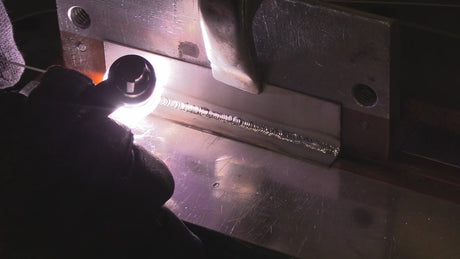
Back to Basics Short Circuit MIG Welding
More MIG Basics Pages and Videos
MIG welding tips for beginners
MIG Welding Settings Simple Chart for short circuit mig
Take advantage of our Free welding workbooks

Click image below to learn more about this Primeweld mts200 mig welding tig welding package

What exactly is short circuit mig welding in simple terms?
First off, we need to have a basic understanding of what the term short circuit mig actually means and how short circuit mig differs from spray mig.
Short circuit mig welding is the most common type of mig welding and is great for hobbyists as well as for light to medium fabrication and maintenance welding.
Spray transfer is more of a heavy duty manufacturing process.
The small 115 volt welders you see at Tractor Supply, Home Depot, Lowes, and other big box stores do short circuit mig as well as flux core welding.
More powerful MIG welders like the PrimeWeld MIG285, MillerMatic 252, Lincoln PowerMIG 256, and other similar size mig welders are also used for short circuit mig welding but are also capable of hotter spray transfer mig as well as flux core welding.
For heavy duty manufacturing spray transfer mig welding, heavier duty mig welding power sources with high duty cycles are needed.
What does the term “Short-Circuit Transfer" Actually Mean?
In short-circuit MIG, the wire is not spraying metal across the arc like it is with spray transfer MIG welding.
Instead, it does this cycle over and over:
1. The wire actually touches the weld puddle
2. The arc goes out (dead short circuit)
3. Current spikes
4. The wire tip heats and necks down
5. The droplet pinches off as the wire blows like a fuse as the arc re-ignites providing heat
6. The cycle repeats
This happens dozens to hundreds of times per second depending on several variables like settings, design of machine, inductance settings, shielding gas, etc.
So short-circuit MIG is really:
A controlled, repetitive electrical short circuit that melts and transfers metal in droplets as well as while wire is fusing into the puddle during the short circuit .
What are the Limitations of short circuit MIG?
- The short circuit mig arc is not as hot as spray transfer and therefore does not penetrate as deeply. Especially with heavy mill scale like you see on hot rolled steel plate.
- Authorities like Millerwelds.com and Lincolnelectric.com usually caution against welding thicker than 3/8" due to lack of fusion concerns.
- Short circuit MIG is not favored by welding codes
What are the Pros and cons of short circuit mig welding?
Pros
- Can weld in all positions...flat, horizontal, vertical uphill, downhill, overhead.
- Great for open root joints
- Can be used for very thin metal like auto body panels up to around 3/8"
- Machine is relatively cheap compared to heavy duty mig welders
Cons
- Is adjustable so welders can use cold settings sacrificing penetration for a pretty weld.
- Quality of weld is largely dependent on welders following best practices like metal prep, settings, and sound technique.
Short Circuit MIG is a great process if used correctly
Here are the keys to sound weld using short circuit MIG:
Remove heavy mill scale
Use a grinder or other method to completely remove heavy mill scale.
Certain metal shapes like square tubing have very light mill scale and can be welded without cleaning but thick hot rolled steel should be ground clean using hard rock, flap disc, or other abrasive that is effective for mill scale.
Good Ground
A good ground is more important than you might think. A poor ground can cause sputtering during the weld and you might think your settings are wrong.
Short electrical Stickout CTWD
Having your contact tip flush or slightly protruding will help you maintain the right electrical stickout or ctwd (contact tip to work distance)
Smart Settings
The mig settings charts on welders will get you close but are usually a bit high as far as wire speed goes. Avoid using excessively low wire speed settings just for the sake of a pretty bead.
The settings on mig charts are intended for flat and horizontal fillet welds and are too hot for vertical uphill. But simply by using the settings for slightly thinner metal usually works and still gets good penetration provided you use a sound technique and short electrical stickout.
Smart Technique
Use a technique that keeps the arc on the leading edge of the puddle. In other words, don't let the puddle get way ahead of the arc.
Dont fear going uphill on 1/4” and thicker
Of course it all depends on the application but on 1/4" and thicker, uphill is way stronger.
Check out these videos on mig welding;