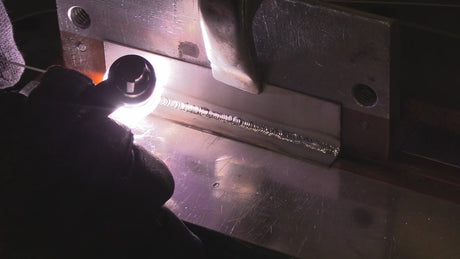
How to TIG Weld a Carbon Steel Tee Joint
A tee joint is a type of fillet weld along with outside corner joints, and lap joints.
Here are some basic practices to help you learn how to weld a carbon steel tee joint:
PLEASE DO TAKE ADVANTAGE OF OUR FREE WELDING GUIDES

Prep the metal.
If its hot rolled steel, remove the mill scale. Light mill scale like you find on tubing can be tig welded without cleaning but it will weld better and cleaner if you sand it down to shiny bright metal

Polarity set to DCEN
The first thing you need to do is make absolutely sure the tig torch is plugged into the correct DINSE port. I am not kidding.
Most modern tig welders have a tig torch icon on the negative port but follow your machines manual.
If you tap the foot pedal and the tip of the tungsten melts and balls immediately, there is a good chance your tig torch is plugged in wrong.
Amperage
There is a general rule of thumb for carbon steel that says one amp per one thousandths of metal thickness is a good starting point.
It works. But it is only accurate up to around 125 thou. (1/8”).
Just as an extreme example, if the one amp per .001" rule worked on all thicknesses, you would need 500 amps to weld 1/2” .500” thick carbon stee
But 125 amps works great on .125” thick carbon steel.
Tungsten type and size
Extremely low amperage welding or really thin metal welding works better with small electrodes like 1/16” and .040”.
High amperage welding on thick metal requires larger diameter tungsten like 1/8” and larger.
To keep things simple, A 3/32" 2% lanthanated Tungsten has quite a range of amperage and works for anything from box cutter blades up to 250 amps on DCEN. It might be the only tungsten you ever need.
Gas lens or Standard Collet Body?
Tee joints tend to hold argon better due to the joint. Both standard collet bodies and gas lenses work fine. The benefit of a gas lens for me is that I can see the tip of the tungsten without tilting my neck.
I have neck issues from football and if I tilt my head all day welding, I can really feel it. With a gas lens, I can extend the tungsten much farther and that makes things way more comfortable for me.

Remember the ABCs of welding
- Always
- BE
- Comfortable
Sometimes, being comfortable requires some effort like putting a clamp nearby to prop on.
A tig finger can also help by letting you prop really close to the hot weld


Electrode extension
Rule of thumb on electrode extension for standard collet body cups is no more than the cup size. Cups are numbered by 1/16s of inside diameter so a number 7 cup is 7/16” and that is your maximum extension. Gas lenses allow for a longer extension.
Furick cups like the jazzy 10 and FUPA12 allow for a much longer electrode extension.


Gas flow rate
The general rule of thumb for argon gas flow rate is 2-3 CFH per cup size so a #10 cup like the jazzy10 ceramic works great with 20-30 CFH. Other factors also play in like a breeze or a drafty welding area.
Filler metal Selection
Filler metal for Carbon Steel can be either ER70S2 OR ER70S6 but follow the welding procedure if there is one.
ER70S6 seems to perform better for full penetration open root pipe welds (if you have the choice)