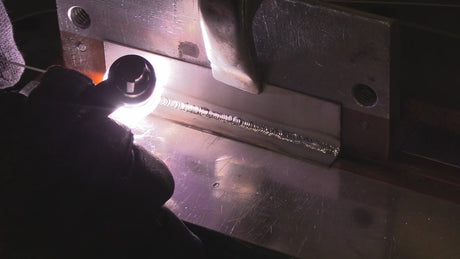
Shielding Gases for TIG Welding Stainless Steels
For TIG welding almost any 300 series stainless steel job or project, Pure Argon might be the only shielding gas you ever need.
But for industrial work on paper mills, refineries, and power plants , there are numerous grades of stainless steels.
So, very specific procedures using argon mixes have been developed to achieve the desired properties.
Here's a breakdown of the most common shielding gases and when to use them, depending on the grade of stainless steel and the welding application.
✅ Most Common Shielding Gases for TIG Welding Stainless
|
Shielding Gas |
Composition |
Applications |
Stainless Grades |
Notes |
|
Pure Argon (100% Ar) |
100% Argon |
Most common choice and most versatile for all grades of Stainless Steels. |
301, 303, 304, 316, 321, 347, 410, 430 |
Clean arc, good penetration, smooth bead |
|
Argon + 2–5% Hydrogen |
98% Ar / 2–5% H₂ |
Better wetting action, faster travel speeds, brighter finish |
Austenitic stainless (304, 316) |
Not for use on ferritic/martensitic grades; avoid on thick or restrained joints |
|
Argon + 1–3% Nitrogen |
97–99% Ar / 1–3% N₂ |
Improves corrosion resistance on certain grades (especially pitting) |
Duplex and super duplex stainless |
Used often for root pass shielding or purging |
|
Argon + Helium (25–75%) |
Ar/He blends |
Higher heat input for thick sections |
All grades, esp. 316, 309, duplex |
Improves travel speed and penetration on thick parts |
|
Pure Helium or He-rich mixes |
100% He or 75% He / 25% Ar |
High heat input, better for thick material |
Not typical for stainless unless thick |
Expensive, harder arc starts |
🔍 Gas Selection by Stainless Steel Type
1. Austenitic (301, 303, 304, 316, 321, 347)
- Best Gas: Pure Argon
- Alternative: Argon + 2% Hydrogen for cleaner, brighter welds (especially 316)
- Notes: Avoid hydrogen on thick, multi-pass welds or if cracking is a concern
2. Duplex (2205, 2507)
- Best Gas: Argon + small % Nitrogen
- Purpose: Nitrogen helps retain proper phase balance and pitting resistance
- Important: Nitrogen may be added to both torch and purge gas
3. Ferritic (409, 430)
- Best Gas: Pure Argon
- Avoid: Hydrogen blends (risk of hydrogen embrittlement)
4. Martensitic (410, 420)
- Best Gas: Pure Argon
- Caution: Preheat and post-heat are often needed; avoid reactive gases like hydrogen
5. Precipitation-Hardening Stainless alloys (17-4PH, 17-7PH, 15-7PH)
- Best Gas: Pure Argon ( A gas lens setup like a Furick fupa12 can make a huge difference for these alloys)
- Notes: Clean welds are critical for mechanical properties
🔄 Back Purge Gas (for full penetration or sanitary welds)
|
Gas Type |
Usage |
Notes |
|
100% Argon |
Most common for purging inside of stainless pipe or tubing |
Ensures no oxidation or sugaring |
|
Argon + Nitrogen (up to 5%) |
Often used on duplex |
Helps retain corrosion resistance |
|
Nitrogen (100%) |
Acceptable in some duplex or tank welding |
Should be paired with proper procedure qualification |
⚠️ Pro Tips
- A dual flowmeter is a convenient way to purge
- Always use high-purity gas (Grade 5.0 or better) to prevent weld contamination.
- Use gas lenses for better shielding coverage on stainless TIG welds.
- Avoid CO₂ in shielding gas for TIG—it's reactive and causes oxidation.
- purge flow rate depends on several variables but usually around 10–20 CFH for most stainless applications; adjust based on cup size and draft conditions.
- For sanitary welding, purging the inside is just as important as shielding the arc. make sure to use appropriate flow rate to avoid suck back on inside