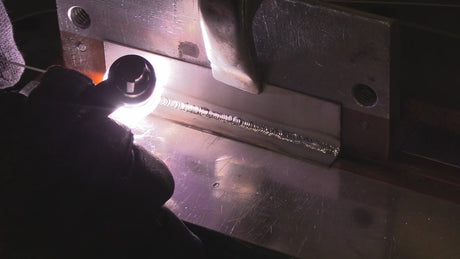
4 - 2F LAP JOINTS 6013 on AC and DC

Return to Main Stick Video Index page
|
Position/Weld |
2F LAP JOINTS 6013 |
|
Base Material Type/Thickness |
Mild Steel 1/8”- 3/16” |
|
Electrode and Diameter |
6013 1/8” |
|
Polarity |
DCEP Direct Current Electrode Positive aka Reverse Polarity (ALSO DCEN & AC) |
|
Amperage |
110-125 |
Return to Main Stick Video Index page
Why 6013 Rods Get a Bad Rap (and When They Actually Shine)
If you hang around welders long enough, you’ll hear 6013 rods called “farmer’s rods.” You’ll also hear guys say they’d rather run a questionable 7018 than a fresh 6013. There’s some truth mixed with a lot of misunderstanding. Let’s break it down in plain language.
Why are 6013 rods called “farmer’s rods”?
It’s not really an insult—it’s more of a nickname that stuck.
6013 rods are:
- Easy to run on both AC and DC
- Easy to strike the arc for restarts
- Forgiving on fit-up and dirty metal
- Smooth, quiet arc with light slag
That makes them good for:
- Gate repairs
- Thin sheet metal
- Light fabrication like 1/8 wall tubing
- General “get it done” repairs
So years ago, if a farmer with only an AC buzz box welder could fix a trailer, a fence, or a piece of equipment.
Translation:
They’re user-friendly rods for non-critical work—not precision structural welding.
Why are 6013 rods not used on nuclear plants or other coded work?
Because nuclear work is all about predictability, toughness, and documented performance.
6013 rods fall short in a few key areas:
- Lower penetration → Not ideal for thick sections or critical joints
- Lower mechanical properties → Especially compared to low-hydrogen rods
- Higher risk of inclusions → Slag can get trapped easier
- Not low-hydrogen → That’s a deal breaker for critical welds
In high-consequence environments like nuclear, pressure vessels, or pipelines, welds need to:
- Meet strict impact toughness requirements
- Resist cracking (especially hydrogen cracking)
- Be consistent across every weld
That’s why you’ll see low-hydrogen electrodes like 7018 (or better yet, GTAW/GMAW processes) used instead.
Why aren’t 6013 rods favored by codes like AWS D1.1?
This is where a lot of people get confused.
AWS code D1.1 is written for structural steel—think buildings, bridges, anything where failure is not an option.
6013 rods are not necessarily prohibited across the board, but they are:
- Limited or restricted in structural applications
- Often excluded from prequalified procedures
Why?
Because D1.1 prioritizes:
- Low hydrogen to prevent cracking
- Reliable penetration
- Consistent mechanical properties
6013 doesn’t check those boxes as well as rods like 7018.
So it’s not that 6013 is “bad”—it just doesn’t meet the margin of safety required for structural code work.
What are 6013 rods actually good for?
This is where people miss the point. 6013 rods are not useless—they’re just specialized.
They shine in:
1. Thin Material Sheet metal
- Light gauge tubing
- Automotive panels
( an overlooked tip is that 6013 and 6011 rods are available in 1/16” and can be used for automotive exhaust although I think 6011 1/16” a better option for downhill)
2. Small Machines (especially 115V)
- Low amperage friendly
- Easy arc starts
- Good for hobby welders or small inverter machines
3. Cosmetic Welds
- Nice bead appearance
- Easy slag removal
- Smooth arc = less spatter
4. General Repairs (non-critical)
- Lawn equipment
- Gates and fences
- Light brackets
5. Training Beginners
They help beginners learn:
- Arc control
- Travel speed
- Basic bead appearance
But here’s the catch:
They don’t teach puddle control the same way 6010 or 7018 does.
Isn’t a 7018 left out in the atmosphere still better than a 6013?
A 7018 is a low hydrogen electrode that can only be left out in the atmosphere for a limited time before it is no longer low hydrogen.
A 6013 rod is not low hydrogen to begin with
This is one of those shop arguments that actually has some truth behind it.
A properly stored 7018 is absolutely superior to 6013 for:
- Strength
- Ductility
- Crack resistance
But when 7018 is left out in the air, it absorbs moisture. That can lead to:
- Hydrogen cracking
- Porosity
- Arc instability
So here’s the honest answer:
- A 7018 left outside is compromised
- A dry 6013 might be consistent but has lower performance
If you’re doing critical work, neither is acceptable:
- You don’t use wet 7018
- You don’t substitute 6013
You fix the problem:
- Re-dry the 7018 in a rod oven per AWSD1.1 or grab fresh rods
If you’re doing non-critical work, then yes:
- A questionable 7018 might still produce a better weld than a 6013
The Bottom Line
6013 rods aren’t junk—they’re just misapplied a lot.
- They’re called “farmer’s rods” because so many farmers only had a buzz box and 6013 run good on a simple AC buzz box
- They’re not used in nuclear or structural work because they lack the properties of low hydrogen rods like 7018
- Codes like AWS D1.1 favor low-hydrogen, higher strength electrodes
- They work great for thin metal, small machines, and general repairs
If you treat 6013 like what it is—a light-duty, easy-running rod—it’ll serve you well.
If you expect it to replace 7018 in structural work, it’s the wrong tool for the job.