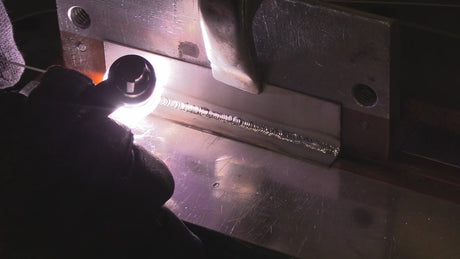
TIG Welding Carbon Steel Basics - Different Filler Sizes on Lap Joints

When the Weld Size on a Drawing Doesn’t Make Sense
One thing that happens in the real world of fabrication and repair is that sometimes a drawing or blueprint calls out a weld size that simply doesn’t make practical sense.
Maybe the weld interferes with a mating part.
Maybe a bolt head won’t clear.
Maybe a bracket has to sit flush against another component.
Or maybe the specified weld size would create unnecessary distortion and cleanup work.
TIG welding is often the process that gives you the precision needed to make a smaller, cleaner weld that still does the job.

Small TIG Welds Require More Precision
Making a tiny fillet weld on 11ga steel or thinner material is not just a matter of turning the amperage down.
Smaller TIG welds usually require:
- Smaller diameter filler metal
- Precise amperage control
- Tight arc length
- Minimal torch angle
- A clean, sharp tungsten electrode
- Good shielding gas coverage
That’s why it often helps to switch to smaller filler rod diameters like .045" or 1/16" when welding smaller fillets or joints with tight clearance requirements.
A large 3/32" filler rod can dump too much metal into a joint too quickly and make it difficult to maintain a small weld profile.
Smaller filler rods give you finer control over how much metal is added to the puddle. That can make all the difference when trying to keep a weld small enough to avoid interference with nearby parts.
The Three Things That Matter Most
Regardless of what filler rod diameter you use, three fundamentals always apply when TIG welding carbon steel:
1. Keep a Tight Arc
Arc length is one of the biggest factors in controlling weld size and puddle shape.
A tight arc concentrates the heat exactly where you want it and helps maintain a narrow, controlled bead profile.
Long arcs spread heat everywhere, widen the bead, reduce shielding effectiveness, and usually create an inconsistent looking weld.
When welding small fillets, a tight arc becomes even more important because there is very little room for error.
2. Limit Torch Angle
Too much torch angle can cause problems. ( fortunately torch angle can be very forgiving if your arc length is tight)
Too much torch angle can cause the tungsten to get crapped up in a fillet weld like a lap joint because the side of the tungsten gets too close to the puddle.
A lot of beginners point the torch too far forward because they are trying to see better. But a gas lens setup with a longer tungsten extension lets you see the puddle better without using excessive torch angle.
For most TIG welding on carbon steel lap joints and fillet welds, limiting the torch angle to around 15-20 degrees helps maintain a focused arc and better shielding coverage.
3. Shield the Hot Tip of the Filler Rod in the Argon
This is one of the biggest habits that separates smooth TIG welds from contaminated ones.
If the hot tip of the filler rod leaves the argon shielding envelope, it oxidizes instantly. (especially with carbon and stainless steels).
Then the next time you dip the rod into the puddle, that oxidation gets carried directly into the weld.
The result can be:
- Dirty looking welds
- oxide specks in the puddle
- Inconsistent bead appearance
Keeping the hot end of the filler rod inside the argon shield between dips helps maintain a smooth, clean weld.
Tungsten Prep Matters More Than Most People Think
When welding small fillets with lower amperage, tungsten prep becomes even more critical.
A clean, sharp tungsten gives you:
- Better arc focus
- Easier arc starts
- More precise puddle control
- Better directional control in tight joints
A blunt or contaminated tungsten makes it harder to keep the weld profile small and controlled.
That’s why many TIG welders regrind tungsten frequently when working on precision welds or smaller joints.
But remember a long tapered needle like point is not always best to pinpoint the arc. a 30 degree taper with the right size tungsten is a great starting point.
Final Thoughts
Sometimes the challenge is not making a weld bigger and stronger.
Sometimes the real skill is making a weld just big enough while still fitting the real-world requirements of the part.
That usually means slowing down, tightening up your technique, and focusing on precision instead of simply adding more filler metal.
And whether you are using .045", 1/16", or 3/32" filler rod, the fundamentals remain the same:
- Tight arc
- Minimal torch angle
- Keep the hot tip of the rod shielded in argon
Those three habits alone will improve your TIG welds more than most people realize.