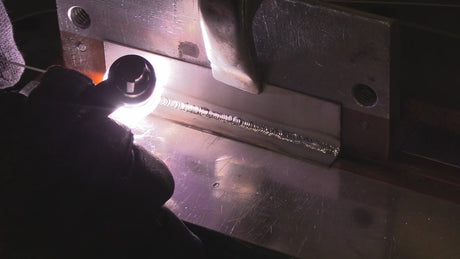
This first Video shows how important a tight arc is...Stick Welding Overhead with 7018 1/8"
Stick Welding Overhead with 5/32" 7018 rod...just a little bit more difficult than 1/8"
Overhead Tube to Plate 7018 5/32"
4g AWS D1.1 standard plate test
Stick Welding overhead with 3/32" 7018 using 115volt power
The video directly above is geared toward students or anyone who struggles with overhead stick welding with 7108.
Its a multi pass fillet weld with a total of 6 beads. So after each bead I will talk about the fundamentals of stick welding using the CLAMS acronym.
C in clams stands for current which is not only amperage , but also includes things like polarity, hot start, DIG or arc control,
The machine I am using for this video is a CK mt200 which is primarily a TIG welder but has stick welding capabilities.
It doesn’t have any other settings for stick welding other than amperage and polarity.
A lot of machines now have hot start and arc control settings.
They are both helpful in preventing sticking the rod.
Hot start gives more amperage for a second or two and arc control aka DIG, senses a drop in voltage when your arc is too tight and increases amperage slightly to help prevent sticking.
Do yourself a favor if you are in school and weld some with both these features turned off so that you won’t be dependent on them.
C also covers cleaning. Is your metal clean enough. Granted stick welding can burn thru mill scale better than most other processes but remember that for a welding test, its better to remove mill scale with a grinder.
L stands for length of arc. I would prefer to be set at 90 amps this situation but I set the machine to 87 to prevent popping the breaker. I experimented and learned that at 87 amps, I can weld as many 3/32” 7018 as I want and not pop the breaker. But at 87 amps, I am being careful not to hold too tight an arc because the machine doesn’t have arc control and a really tight arc will stick.
I usually give this advice for stick welding overhead. “ set your amperage high enough that the rod won’t stick when you hold a tight arc…then hold a tight arc!”
But that does not take into account concerns about not popping a breaker.
Angles. Angle of rod and travel can be very forgiving provided your arc length is tight enough. I thought I was using a slight drag angle for most of the beads but the camera showed I was either 90 deg or slight push.
It just goes to show that as long as you are not using extreme angles, things work out ok.
M for manipulation. A 7018 can definitely be used with straight stringers with no manipulation but sometimes a slight motion helps the bead to flatten a bit. Certain weld procedures might even prevent any manipulation.
S is for Speed. Stick welding is a slower process than say dual shield flux core. Go slow enough not to leave undercut but fast enough to not build up too much crown.
S also covers shielding. A stick weld gets its shielding from the flux.
Flux not only creates slag that protects the molten puddle from the air, but also creates gases that help shield the arc and molten puddle.
So inspect your rod before welding to make sure there are not breaks in the flux.
A 3/32” 7018 stick rod can be just the ticket for certain situations.
Running off a 115 volt outlet is one of those situations.
I do have 230volt power but sometimes I like to see what my machines can do on 115 volt.