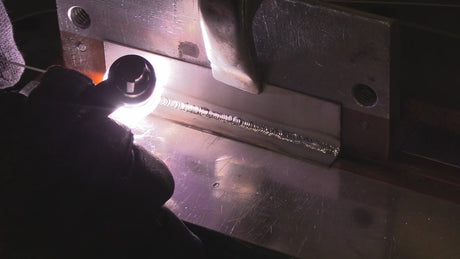
Why your TIG welder may weld thicker aluminum at 50 Hz than 250 Hz

According to Miller, Lincoln, Fronius, and other TIG Machine companies, higher AC frequency gives you a tighter, more focused arc.
That’s true. But that doesn’t mean higher is always better.
Sometimes turning the AC frequency down is exactly what you need—especially when you are running out of amperage.
If your TIG welder is maxed out, or you’re plugged into 115-volt power and the machine can’t give you all the amperage you want, a lower AC frequency setting like 50 Hz can put more heat into the aluminum and help you establish a puddle quicker.
That’s one reason I think it’s worth understanding what AC frequency actually does instead of just picking 120 Hz or 200 Hz and leaving it there.

1. What Does AC Frequency Actually Do?
- AC frequency is how many AC cycles happen per second.
- 50 Hz = 50 cycles per second.
- 100 Hz = 100 cycles per second.
- 250 Hz = 250 cycles per second.
- Changing frequency changes the way the arc behaves and how concentrated the heat is.
- It does not mean that higher frequency automatically means a hotter weld.
- Higher frequency settings cause some loss of heat input due to all the time spent switch back and forth from Electrode negative to electrode positive
When the Miller Dynasty TIG inverters first came out, like a lot of folks, I read some literature about how using higher frequency settings with the miller dynasty 700 could puddle thick aluminum quickly without a preheat and that really got my attention.
I guess I just automatically assumed that higher AC frequency settings were better for thicker aluminum across the board.
During my last few years with Delta Airlines TechOps, we got a few Dynasty 350 machines in to replace some Syncrowave 250 welders that were set up with an argon helium mix to weld magnesium and aluminum gearboxes. Some of the guys still preferred the Syncrowaves.
Then a few years later when I got to attend the Lincoln advanced motorsports welding class, they had a station set up with a cast aluminum cylinder head with some grooves milled out for practice welds. The machine at that station was a Lincoln Aspect 230 inverter.
The machine was set to around 150-200hz and when I tried to weld one of the grooves,even at max amperage with the foot pedal floored, I couldn’t even puddle the aluminum.
One of the other students told me he remembered one of the instructors telling him that with that machine, a lower AC frequency setting of 50hz worked better.
So I lowered the frequency to 50hz and that made all the difference.
So that’s when I finally understood the thing that no one talks about:
Higher AC frequency settings on thick aluminum only work if you have plenty of amperage to play with.
2. What Happens at Lower AC Frequency?
Lower AC frequency tends to produce a broader arc and can put more heat into the work at a given amperage.
- The arc is wider and less focused.
- The puddle can establish faster when amperage is limited.
- The weld bead might be a bit wider.
- The arc may not feel as stiff or precise as it does at higher frequency.
- But sometimes heat is what you need more than precision.
3. What Happens at Higher AC Frequency?
Higher frequency constricts the arc and makes it more focused.
Talk about the advantages:
- Tighter arc
- More directional control
- Narrower weld
- Useful around edges, corners and tight areas
- Can make the arc feel more precise
That tighter arc doesn’t necessarily mean you are getting more useful heat into a thick piece of aluminum.
At the same amperage, very high frequency can make it harder to get the puddle established when the machine is already close to its limit.
4. The Part That Often Gets Overlooked: Available Amperage
There is a big difference between:
having enough amperage available
and
trying to make a limited amount of amperage do the job.
If you have a 300-amp machine and only need 200 amps, you have room to work. You can run higher frequency and compensate with more amperage.
But if you have a 200-amp machine and the job really wants everything that machine has, frequency becomes much more important.
High frequency works great when you have enough horsepower behind it. But when the machine is already giving you everything it has, lowering the frequency can help you get more work out of the amperage you have.
5. This Becomes Even More Important on 115-Volt Power
- A dual-voltage TIG welder usually produces considerably less output on 115 V than on 230 V.
- On 115 V, you are probably plugged into a 20 amp breaker.
- You may have plenty of machine but not enough input power to access its full output.
- Aluminum takes a lot of amperage compared with steel or stainless.
- Thick aluminum also pulls heat away from the weld very quickly.
So if you are on 115 V and struggling:
Before deciding the machine simply won't weld the aluminum, try lowering the AC frequency.
6. 50 Hz vs 250 Hz — Same Amperage
I set up a round piece of .070" thick 6063 aluminum on a turntable and ran one bead at 50hz and one at 250hz.
Thte 50hz bead penetrated fully
The 250hz bead did not penetrate at all
Same aluminum.
Same joint.
Same tungsten.
Same AC balance.
Same amperage.
Only thing that was changed was AC frequency.
7. Higher Frequency Isn't Bad
The takeaway shouldn't be:
"50 Hz is better."
It should be:
"Use AC frequency Settings to your advantage by knowing how to set it to solve the problem in front of you."
If you have plenty of amperage, higher frequency settings can work extremely well—even on thicker aluminum.
If you are amperage-limited, lower frequency may work better.
If you need a tight, focused arc around an edge or in a tight joint, higher frequency may be worth the extra amperage requirement.
8. A Simple Way to Think About AC Frequency
Need more heat from limited amperage? Try lower frequency.
Need a tighter, more focused arc and have plenty of amperage? Try higher frequency.
There are plenty of other variables involved—AC balance, tungsten size, torch angle, arc length, joint design and even the machine itself—but understanding this one principle can help you get the job done.
This is the reason I wouldn't buy an inverter TIG welder for aluminum that doesn't have adjustable AC frequency. It's not just a setting for making the arc feel or sound different.
It gives you another way to make the machine work for the job—and sometimes lowering the frequency can make the difference between struggling to get a puddle and getting the job done.