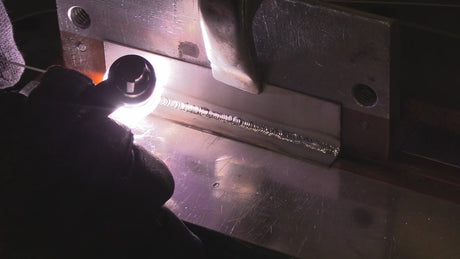
I don't know how many different colors of tungsten there are but there's a lot of them.. and it can be kind of confusing especially for a beginner. In this video I tested five different colors, it's not an extensive test but it's down and dirty and I think it will be a huge help to anyone just getting started or looking to learn a little more.
I personally use 2% lanthanated tungsten for everything.
It works really well for what I do and using only one type makes life simpler for me.

A very common question is...
"What size tungsten should I use for what"?
Some sources say you should use the smallest diameter tungsten that will handle the job.
Others say you should use the biggest tungsten that will still get good arc starts.
I think the truth lies somewhere in the middle of these two ideas.
When does it make sense to use an .040” diameter tungsten?
Assuming your are using either 2% lanthanated, E3, or CK LaYZr, the safe max amperage for .040” is around 60 for DCEN and 45 for AC depending on machine settings.
Most sources will state much higher max amps but in my experience, there is too much risk of dumping or spitting tungsten in the weld at higher amperages.
So if you need a really low amperage start and dont need to go over 60 on DC or 45 on AC, an .040” tungsten will work well.
Let me just say this though. In all my welding on aircraft parts, I only needed to use .040” tungsten once or twice and that was on a stainless lap joint welding an .012” doubler to .020” thickness.
There are certain industries where micro tig is done at very low amps and that is most likely where .040” is needed. But for most of the aerospace welding I was exposed to 1/16” was the workhorse for DCEN welding from 5 up to around 100 amps.
The smaller the diameter the easier and quicker to sharpen so if you are using a tungsten grinder with a diamond wheel, an .040” will be easier on the diamond wheel than larger diameter tungsten.
When does it make sense to use an 1/16” diameter tungsten?
I was a pipe welder for 13 years and all I ever used was 3/32” and 1/8” tungsten.
But my first day on the job in the aerospace mtc welding industry, 90% of the torches had 1/16” tungsten.
Only the aluminum and magnesium booths used 3/32” and 1/8”.
And in certain shops like the blade and vane shop and the hot section shop, 1/16” was used for everything because amperage was always under 100 in those shops (in fact, in the blade and van shop amperage was usually under 50) .
If you are always welding on DCEN and less than 100 amps, 1/16” makes sense because it is much cheaper and quicker/easier to sharpen.
When does it make sense to use an 3/32” diameter tungsten?
If you have a 200 amp tig welding machine, 2% lanthanated tungsten might be all you ever need and only needing one size and type of tungsten can sure make things simpler. A 2% lanthanated 3/32”tungsten can handle 200 amps on AC and and also works ok for low 5 amp starts on razor thin material provided its sharpened correctly and to a 30-40 degree tip.
When does it make sense to use an 1/8” diameter tungsten?
Some people keep a 1/8” tungsten in the torch for everything.
They just sharpen it like a needle for thin metal and prepare the tip accordingly for thicker steel and aluminum.
Nothing really wrong with that but 1/8” tungsten is much more expensive than smaller diameters and also wears out a diamond wheel quicker if you are using a tungsten grinder.
For all of the type of work I have done...from pipe welding to aerospace, to job shop welding, I prefer using the right size tungsten for the job and switching to 1/8” when I need to rather than trying to weld everything with 1/8".
Personally, I get crisper arc starts using 3/32” on 1/8” and under aluminum and also on thin steel…and it only takes me a few seconds to switch out tig torch hardware.
Most of what you have seen me do in videos has been with a 3/32" 2% lanthanated tungsten because it is the most versatile size and type.
When does it make sense to use an 5/32” diameter tungsten?
High amperage aluminum is the most common reason to need 5/32” diameter tungsten.
A great example of the type of work that needs 5/32” tungsten is Brian Lambert aka @rollingbombfab on IG.
Brian routinely welds 1/4” and thicker tread plate for utility vehicles.
He often uses 5/32” tungsten with a rounded tip and a gas lens.
He is one of the best aluminum welders I know…or maybe I should just say “best welder” because his skills extend way beyond just aluminum …check him out on instagram https://www.instagram.com/rollingbombfab/