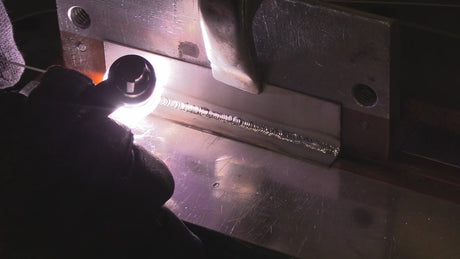
Short Circuit MIG is often used beyond its limits and even used where other wire fed processes like pulse spray or dual shield flux core might be a better choice.
There are plenty of shops out there pushing the limits of short circuit MIG but aren’t getting the most out of it due to one simple mistake.
Here is a story is about a short circuit mig welding problem that was easily cured with one simple fix.
Let me give you the back story.
During my time with Delta Airlines TechOps, Delta merged with Northwest.
But several years before that happened Northwest had a shop across the road from Delta TechOps in Atlanta where a few ground equipment mechanics built and repaired hangar equipment.
They had a big project coming and wanted us to certify a few of their mechanics to our procedures. ( we had qualified procedures for short circuit mig)
So our management teams agreed for us to go across the street to their shop and administer some 3g and 4g plate tests.
We had 6 guys testing on 3g and 4g plates each and so It was taking quite a while using only one Miller 250 mig welding machine.
So I suggested we get 2 welding stations setup because I saw an older Miller mm200 machine in the corner not being used.
“Oh that machine welds like crap! we would rather not use it.”
Now I knew that a miller mm200 had a reputation for having a really nice arc so I took a look at it to see if I could see anything out of the way.
I knew what a difference ctwd can make from a bunch of research I had done…
And also from my own testing and experimenting and even from using an ammeter to demonstrate to students how amperage drops when a long stick out is used.
So I picked up the mig gun for a peek and Sure enough the contact tip / nozzle configuration had the contact tip recessed way back in the nozzle at leat 1/4”.
So I asked if they had any shorter nozzles or longer contact tips. “Nope that’s all we got”.
So then I noticed they had a lathe. I asked one of the mechanics if he could chuck up the nozzle and turn it down about 1/4” or more to where the contact tip would be just past flush.
Then I asked the guy who said the machine welded like crap to give it a try on a simple tee joint. He couldn’t believe the difference.
So we finished up the testing a lot quicker using 2 machines and they started using that mm200 again. A big win overall and I will never forget that lesson about ctwd.
I often use the term stickout or electrical stickout but technically speaking contact tip to work distance or ctwd is more accurate. Either way, keep it short for short circuit mig.
Longer electrical stickout is often needed for spray or dual shield flux core but for short circuit, keep that ctwd short.
LEARN MORE ABOUT THE PRIMEWELD MTS200 MIG, DC SCRATCH START TIG, AND STICK

There are subtle differences in the technical definitions of stickout, electrode extension, and CTWD (contact tip to work distance)
CTWD = Electrical Stickout + Arc Length
Difference in Stickout and CTWD (contact tip to work distance)
1. What is CTWD? (Contact Tip to Work Distance)
CTWD = the physical distance from the end of the contact tip to the surface of the workpiece.
In other words:
It’s what you would measure with a ruler from the contact tip to the metal.
CTWD includes everything between the contact tip and the workpiece, which is:
- The length of unmelted wire sticking out of the gun
- Plus the arc length
So:
CTWD = Electrical stickout + Arc length
- What is “stickout”? The AWS defines stickout as The length of unmelted electrode extending beyond the end of the gas nozzle. So if the contact tip is flush with the nozzle, stickout, and electrode extension could be the same.
Personally, I like my contact tip slightly protruding past the end of the nozzle for short circuit mig welding so I can keep my stickout short
3. What is Electrical Stickout?
Electrical stickout = the length of wire that is electrically “hot” between the contact tip and the arc.
In other words:
It is the length of unmelted wire from the contact tip to where the arc actually starts.
This is sometimes called:
- “Stickout”
- “Electrode extension”
But the important idea is:
- The arc does not start at the contact tip
- The arc starts at the end of the solid wire
- Everything between the contact tip and the arc is resistively heated wire
That resistive heating is a big deal because:
The longer the electrical stickout, the more the wire preheats before it ever reaches the arc.
Hot wire melts differently than cold wire.
4. The Key Difference (This Is the Whole Point)
CTWD includes the arc.
Electrical stickout does not.
So:
- CTWD = contact tip → workpiece
- Electrical stickout = contact tip → start of arc
Or in equation form:
CTWD = Electrical Stickout + Arc Length
5. Why This Matters in Real Welding
Electrical stickout directly affects:
- Welding current (amps)
- Wire burnoff rate
- Penetration
- Bead profile
Longer electrical stickout:
- Increases resistance heating of the wire
- Causes the wire to melt faster before it reaches the puddle
- Reduces current (amperage)
- Generally reduces penetration and “softens” the arc
CTWD, on the other hand:
- Is what the welder actually controls with their hands
- CTWD can also be preset for mechanized applications like when a stationary mig gun is used on a turntable.
6. When CTWD and Electrical Stickout Are (Almost) the Same
They become the same when arc length is extremely short.
This happens in:
- Short circuit transfer
- Very tight arc conditions
In short circuit MIG:
- The arc length is often only a few thousandths of an inch
- The wire is constantly touching the puddle
- So:
CTWD ≈ Electrical Stickout
Not perfectly equal — but close enough that people often use the terms interchangeably just like people use the words engine and motor interchangeably
7. When They Are Very Different
CTWD and electrical Stickout differ more in:
- Spray transfer
- Globular transfer
- Any long-arc condition
In those cases:
- Arc length can be 1/8" or more
- So CTWD might be 3/4"
- But electrical stickout might only be 5/8"
- Think of an open root on a pipe joint . Ctwd and stickout are almost the same
Same CTWD, different arc length = different electrical stickout = different amperage and arc behavior.
Summary
CTWD is the total distance from the contact tip to the work, electrical stickout is only the length of hot wire before the arc, and in short-circuit MIG they can be almost the same because the arc is so short — but in spray transfer mig or globular transfer they can be very different and that difference changes amperage, penetration, and arc behavior.
CTWD = Electrical Stickout + Arc Length