ER312 vs ER309
Which TIG Filler Rod Is Better for Unknown Steel?
LEARN MORE ABOUT WASHINGTON ALLOYS ER309L AND ER312 FILLER ROD

Sometimes you know exactly what you're welding.
Other times you don't.
Maybe somebody brings you a broken machine part, shaft, bracket, tool, or piece of equipment and says:
“I don't know what kind of steel this is. Can you weld it?”
Now filler-metal selection gets more interesting.
Two stainless TIG filler rods worth knowing about for dissimilar and difficult-to-weld steels are ER309 and ER312.
- Both have high chromium and nickel contents compared with ordinary carbon-steel filler metals.
- Both can tolerate considerable dilution from other steels.
But ER312 has one characteristic that makes it especially interesting for unknown and difficult-to-weld steels:
It produces a weld deposit with a large amount of ferrite, which gives it very good resistance to weld-metal cracking.
So if the question is:
“Which filler rod would I rather have when somebody hands me an unknown piece of steel?”
For those situations, ER312is usually a great option.
But that doesn't mean ER312 is always better than ER309.
There are applications where ER309 makes more sense.
ER312 vs ER309 Chemical Composition
The chemistry helps explain the difference between these two filler metals.
AWS A5.9 chemistry ranges are approximately:
|
Element |
ER312 |
ER309 |
|
Chromium |
28–32% |
23–25% |
|
Nickel |
8–10.5% |
12–14% |
|
Carbon |
0.15% max |
0.12% max |
|
Manganese |
1.0–2.5% |
1.0–2.5% |
|
Silicon |
0.30–0.65% |
0.30–0.65% |
|
Molybdenum |
0.75% max |
0.75% max |
The main difference in these filler rods is:
ER312= roughly 30% chromium and 9% nickel
ER309 = roughly 24% chromium and 13% nickel
That difference in the chromium-to-nickel balance has a major effect on the weld-metal microstructure.
ER309 weld metal is primarily austenitic with some ferrite.
ER312normally produces a duplex ferritic-austenitic weld-metal structure with considerably more ferrite.
Having some ferrite in the weld metal generally improves resistance to solidification cracking.
Its combination of very high chromium—around 30%—and relatively low nickel—around 9%—creates a weld deposit containing a substantial amount of ferrite along with austenite.
That two-phase microstructure gives ER312 excellent resistance to weld-metal cracking.
Why Dilution Matters With Unknown Steel
When you TIG weld two pieces of metal together, the weld isn't made entirely from the filler rod.
You melt some of each base metal into the puddle.
That means the final weld-metal chemistry is a mixture of:
Filler metal + Base metal #1 + Base metal #2
That's called dilution. Also known as admixture.
If you know exactly what the base metals are, you can make a reasonably educated prediction about the resulting weld-metal chemistry.
But what If the steel is unknown?
- It might be mild steel.
- It might be medium-carbon steel.
- It might be high-carbon steel.
- It might be a hardenable alloy steel.
- It might be some type of 300 series stainless steel.
- It might be a 400 series stainless
These situations are where ER312 can be a useful problem-solving filler rod
Its high chromium-to-nickel ratio gives it enough ferrite-forming potential that the weld deposit can tolerate considerable dilution while still retaining a two-phase ferritic-austenitic structure.
ER312 Wasn't Originally Designed as an “Unknown Steel” Filler
Here's an interesting bit of history.
ER312 was originally intended for welding cast alloys having similar chemistry.
But its unusual weld-metal characteristics made it useful for
welding dissimilar metals and difficult-to-weld steels.
That is why ER312 has developed such a strong reputation as a very crack resistant versatile maintenance rod.
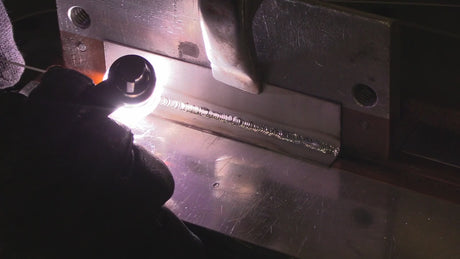
TIG welding some Chromium Vanadium wrenches using ER309 TIG ROD
There are even several companies who make rods similar but not necessarily identical to the composition of ER312 but use fancy names like "Selectrode 6007" or "Supermissileweld".
Those rods with catchy names sometimes work really well but can be expensive.
Typical applications for ER312 tig rods can include:
- Dissimilar steels
- Unknown steels
- Difficult-to-weld steels
- Tool steels
- Hardenable steels
- Machine components
- Repair welding
- Some high-strength steels
- Jobs where previous welds have cracked
(I remember working a fab shop many years ago where they kept some 312 stick rods on hand for difficult to weld steels.)
But ER312 Doesn't Prevent Every Type of Cracking
This is an important distinction.
When we say ER312 is highly crack resistant, we're mainly talking about the weld deposit.
The base metal can still crack no matter what filler rod is used.
Suppose the mystery steel turns out to be a high-carbon or hardenable alloy steel.
The heat from welding can create a very hard martensitic heat-affected zone next to the weld…regardless of the filler metal used.
Now you might have a perfectly sound ER312 weld deposit sitting next to a cracked HAZ.
That's why filler-metal selection is only one part of repairing unknown steel.
Depending on the application, you may also need to think about:
- Preheat
- controlling Interpass temperature
- slowing the Cooling rate
- Hydrogen
- Joint restraint
- Base-metal hardness
- Postweld heat treatment
- Actual material identification
ER312 is super useful, but it isn't magic.
Where Does ER309 Fit In?
ER309 is also an extremely useful dissimilar-metal filler.
Its nominal composition is roughly 24% chromium and 13% nickel.
That additional chromium and nickel compared with 300-series base metals allows ER309 to tolerate dilution from carbon and low-alloy steels.
One of its classic applications is joining 300 series stainless steel to carbon steel.
This video shows welding carbon steel pipe to a stainless flange using ER309L tig rod
When Might ER309 Be Better Than ER312?
There are several situations where I would consider ER309 instead.
Known Stainless-to-Carbon-Steel Joints
If I know I'm welding an austenitic stainless such as 304 to ordinary carbon steel, ER309 is a very logical filler-metal choice.
I know what both materials are.
I understand the dilution.
And ER309 is specifically designed for this type of dissimilar-metal welding.
Elevated-Temperature Applications
This is an important distinction.
ER312's high ferrite content can become a disadvantage during prolonged elevated-temperature service because ferrite can transform into brittle intermetallic phases.
ER309 has a long history in elevated-temperature applications.
And this is where the difference between ER309 and ER309L actually matters.
ER309 is allowed to contain considerably more carbon than ER309L.
That higher carbon can provide better elevated-temperature strength than the low-carbon version.
So if we're talking about a known application involving elevated temperatures, ER309 may make much more sense than ER312.
Of course, filler-metal selection for critical high-temperature service should be based on the applicable code, engineering requirements, and actual operating temperature.
“What filler is least likely to crack on this unknown piece of steel?”
Strength Is Another Reason ER312 Gets Used for Repairs
ER312 weld deposits can also have relatively high tensile strength.
ER309 vs ER312— Comparison
|
|
ER309 |
ER312 |
|
Nominal Cr |
~24% |
~30% |
|
Nominal Ni |
~13% |
~9% |
|
Carbon |
≤0.12% |
≤0.15% |
|
Structure |
Austenitic + some ferrite |
Ferritic-austenitic / duplex |
|
Ferrite potential |
Moderate |
Very high |
|
Weld-metal crack resistance |
Very good |
Excellent |
|
Stainless to carbon steel |
Excellent application |
Can work, but often unnecessary |
|
Unknown/difficult steels |
Useful |
Particularly useful |
|
Tool/hardenable steel repairs |
Possible depending on application |
Common problem-solving application |
|
High-temperature service |
Can be appropriate |
High ferrite can be a limitation |
|
General repair rod for mystery steel |
Good |
Often especially attractive |
So Which Is Better for Unknown Steel?
If I know exactly what I'm welding, I prefer to select the filler metal based on the actual base-metal combination and service requirements.
If I'm welding 304 stainless to mild steel, ER309 is an obvious filler to consider.
But that's different from somebody handing me an old broken machine component and saying:
“I have no idea what kind of steel this is.”
Now I have uncertainty.
I don't know how much carbon is present.
I don't know the alloy content.
I don't know how the unknown steel is going to dilute the filler metal.
And I don't know how crack-sensitive the resulting weld deposit might be.
That's where ER312's chemistry gives it an advantage.
Its approximately 30Cr-9Ni composition produces a highly ferritic-austenitic weld deposit that retains very good resistance to weld-metal cracking even with substantial dilution.
That's the main reason I would consider ER312 for unknown steel.
But there's one more point worth repeating:
ER312 can help prevent the weld metal from cracking. It can't guarantee that an unknown hardenable base metal won't crack in the heat-affected zone.
For a noncritical repair, ER312 can be an extremely useful filler rod to have in the toolbox.
For a critical component, identifying the steel and developing the correct welding procedure is still the better approach.
Bottom Line
Here's the simplest way I know to think about it:
Known stainless-to-carbon-steel joint? ER309 is often a very good choice.
Unknown or difficult-to-weld steel where weld-metal cracking is the main concern? ER312 starts looking very attractive.
ER309 is a proven dissimilar-metal filler.
ER312 is more of a problem-solving filler metal.
And that's exactly why I think ER312 deserves a place in the TIG filler rod drawer of anyone who does much repair welding.