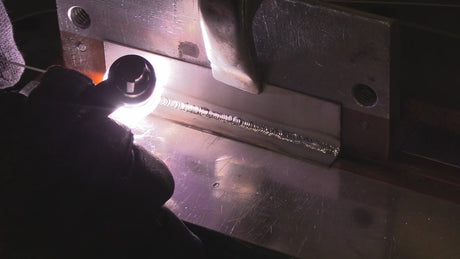
More Padding Beads – Building Skill and Control for TIG Welding Carbon Steel

Learn more about clear cups here or click pic below

Go to Main Index page for TIG Welding Carbon steel Basics
Once you’ve got consistent stringer beads down, and have increased your wire feeding skills by padding beads on aluminum, the next step is to fine tune your carbon steel beads by: padding beads on carbon steel plate.
This simple exercise forces you to focus on torch angle, arc length, filler timing, and heat management — all in one place.
🎯 What is a bead pad (aka “padding beads”)?
Just like the Aluminum Drill, A carbon steel bead pad is a series of overlapping TIG beads laid side-by-side on a flat plate. Instead of laying a single stringer, you cover the surface with multiple beads — typically as many overlapping beads as it takes while focussing on consistency in:
- Bead width
- Overlap and spacing
- Arc control
- Filler feeding
- Heat input my controlling foot pedal or torch mounted amp control
🧰 What you’ll need
-
Mild steel plate, 1/8" to 1/4" thick
(3" x 6" or 4" x 8" is ideal) or any piece of round stock you can find -
ER70S-2 or ER70S-6 filler rod
(1/16" or 3/32" ) - Sharp tungsten (2% thoriated or 2% lanthanated)
- 100% argon at 15–20 CFH ( or 2 to 3 CFH per cup size)
- Cup size #6–#8, preferably with a gas lens
- TIG welder set for DCEN, ~110–140 amps depending on thickness and rod size
🔧 Step-by-step bead pad drill
1️⃣ Prep the plate
- Clean both sides with a flap disc or grinder to remove mill scale
- Wipe with acetone to remove oil or dirt
- Clamp or tack to a backer to prevent movement
2️⃣ Run your first stringer bead across the plate
- Start about 1/2" from the edge
- Focus on consistency in travel speed, arc length, and filler addition
- End cleanly by tapering off amperage
3️⃣ Overlap the previous bead by 50%
- Think of it like “shingling” your welds across the plate
- Each weld bead should overlap the previous bead by half to avoid low spots or humps
4️⃣ Repeat until you fill the surface
- Let the piece cool off after every 2 or 3 beads. It works better if you have 2 pieces so that one can cool off while you weld on the other.
- Try to keep each bead consistent in width and shape
- Watch for excessive heat buildup — the puddle will get squirrelly if it gets too hot
🔁 Variations to increase difficulty
- Alternate direction with each pass (left to right, then right to left)
- Try it with different cup sizes to see how gas coverage changes
- Use a phone or camera to film yourself and evaluate torch angle and how your filler rod hand is working
- Once one side is full, let cool, clean and use the other side
❗ What you’re learning
Padding beads develops muscle memory in key TIG welding skills:
|
Skill |
What to Focus On |
|
Arc length |
Keep it tight and steady across the entire pad |
|
Torch angle |
10–15° push angle, consistent from start to stop |
|
Travel speed |
Maintain bead width and ripple spacing |
|
Filler timing |
Dip or feed consistently for even build-up |
|
Heat control |
Monitor puddle size, discoloration, and distortion |
📌 Summary
The pad of beads is a TIG welder’s proving ground. It’s not just about making pretty beads — it’s about training your hands, eyes, and instincts to work together. By running overlapping beads across a plate of carbon steel, you’re building the consistency and finesse that carry over into every weld joint you’ll ever make.