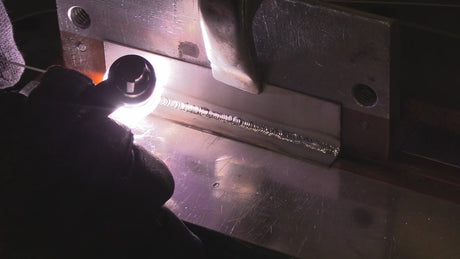
Rooftop OVERHEAD 7018 3/32 Stringers

Return to Main Stick Video Index page
|
Position/Weld |
Overhead Roof Top 7018 3/32“ stringers |
|
Base Material Type/Thickness |
Mild Steel 1/4”- 3/8” |
|
Electrode and Diameter |
7018 3/32” |
|
Polarity |
DCEP Direct Current Electrode Positive aka Reverse Polarity |
|
Amperage |
90 amps |
Stick welding overhead with 3/32” 7018
The main 5 things are:
- How clean does the metal need to be?
- What polarity and amperage is best?
- How long should my arc length be?
- How should I manipulate the electrode…or should I NOT manipulate at all?
- How slow or fast should I travel?
How clean does the metal need to be?
Stick electrodes will penetrate thru hot rolled mill scale. But undercut will be much less likely if mill scale is removed with a grinder.
What polarity and amperage?
Generally DCEP is the recommended and preferred polarity for 7018 rods and one amp per thousandths of thickness will get you pretty close on amperage. So a 1/8” 7018 is .125” and 125 amps is a great starting point for amperage whether overhead or flat. A 3/32” 7018 is .094” so 94 amps might be a tad hot for some brands but is still a good starting amperage for some brands of 3/32” 7018 like the Lincoln excalibur in the flat position. A setting of 80-85 amps is often used for vertical uphill welding. 85 to 90 amps seems to work with most brands of 3/32” 7018 for overhead.
How long should my arc length be?
rule of thumb for arc length is one electrode diameter but remember that the core of 7018 is recessed inside the cone created by the way the flux melts off. Even a tight arc will be longer than you might think due to the solid metal core of the rod burning up inside the flux coating.
My age old advice for stick welding overhead with a 7018 is to set machine where the rod won’t stick when you hold a tight arc…then hold a tight arc.
(The Arc control aka Dig setting can definitely affect how tight an arc you can hold at a given amperage but that’s a topic for a different video and article.)
How should I manipulate the electrode…or should I not manipulate it at all?
No manipulation is required but sometimes it definitely helps the bead flatten out.
(some welding procedures limit the amount of manipulation aka weaving)
How slow or fast should I travel?
travel slow enough to avoid undercut. But go fast enough to prevent too much heat buildup and to prevent a highly crowned bead.