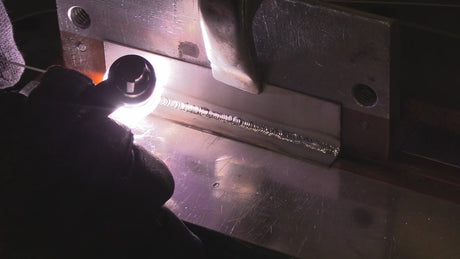
The 4 Basic Features to look for in a TIG welding machine for Aluminum are:
- Adjustable Pre Flow
- AC balance
- AC Frequency
- Adjustable Post flow
Adequate Pre Flow Helps Reduce Black Soot on aluminum arc starts

Learn more about this AC/DC TIG welder under $1000
See the Complete FAQ page for the Primeweld TIG225x
Download our Free Aluminum TIG Guide here

Black soot at the start of an aluminum bead is often caused by inadequate gas shielding.
If you’ve ever noticed:
- A clean bead after the first 1/4 inch
- But a dirty, sooty start area
That’s often a pre flow gas shielding issue.
Simply put, the argon shielding gas has not had time to provide an oxygen free arc start.
Pre flow helps eliminate that by ensuring:
- Argon is already in place when the arc starts
- Oxygen is pushed out of the arc area
How Much Pre Flow Do You Need?
You don’t need a lot for most steels when using a small cup with short stickout.
But for aluminum, a full 1.5 seconds is sometimes needed in order to get a perfectly clean arc start that is soot free.
Typical pre flow settings:
- Around 1 to 1.5 seconds for most work
Enough time to establish gas coverage before the arc starts.
Too little pre flow time → poor protection
Too much pre flow time → just wasting gas
If you happen to get a good deal on a tig welder without adjustable pre flow, the workaround is to just tap the foot pedal to get the argon flowing before you start welding but over time, this method wastes argon as opposed to a proper pre flow setting of 1 to 2 seconds.
Why This Matters When Choosing a TIG Welder
If you’re shopping for a TIG welder for aluminum, make sure it has:
-
Adjustable pre flow - some welders either don't have a pre flow setting or its preset at around 0.5 second...not quite enough time for aluminum
- Smooth arc starts on AC can sometimes be improved by increasing the start amps
if you are welding high end aluminum parts where the customer demands a clean stack of dimes where restarts are almost undetectable, then pre flow matters a lot.
A clean start sets the tone for the entire weld.
Simple Rule of Thumb
If your arc starts dirty, your restarts will be obvious.
Pre flow is one of the easiest ways to prevent that.
Pre flow isn’t a flashy feature.
But it directly affects:
- Arc starts
- Tungsten life
- Weld cleanliness
- First impressions of your weld
AC Balance Setting
Learn more about this AC/DC TIG welder under $1000
See the Complete FAQ page for the Primeweld TIG225x
If I’m buying a TIG machine for aluminum, one thing I’m not willing to give up is adjustable AC balance.
You can get by without a lot of features.
You can live without pulse.
You don’t need a fancy screen.
But no adjustable AC balance?
That’s a hard pass for me.
Let me explain why.
Why I Would Not Buy a TIG Welder Without Adjustable AC Balance
First — What AC Balance Actually Does
When you TIG weld aluminum on AC, the machine is constantly switching between:
- Electrode Positive (EP) → cleaning action (breaks up oxide)
- Electrode Negative (EN) → penetration and heat into the metal
AC balance lets you control how much time the arc spends in each part of that cycle.
So in simple terms:
- More EP = more cleaning
- More EN = more penetration and a cooler tungsten
That balance is not something you want locked in.
Aluminum Is Not One-Size-Fits-All
Different aluminum jobs need different amounts of cleaning.
Examples:
- Clean, new aluminum → very little cleaning needed
- Dirty or oxidized aluminum → more cleaning required
-
Cast aluminum → often needs more cleaning
If your machine has a fixed AC balance, you’re stuck with whatever the manufacturer decided.
Sometimes that works fine.
Sometimes, it doesn’t.
Too Much Cleaning Causes Problems
While Some Machines without adjustable AC balance are fixed at around 70% EN, Others lean toward too much EP (cleaning) to make them more “forgiving.”
But too much cleaning causes its own issues:
- Overheats the tungsten
- Causes the tungsten to ball up excessively
- Widens the arc
A wide, soft arc is the opposite of what you want for precise work.
Not Enough Cleaning Is Also a Problem
On the other side, if there’s not enough cleaning:
- The oxide layer isn’t removed properly
- The puddle looks dirty
- You can get black soot
- easy to get porosity
Adjustable AC balance lets you:
- Fine-tune arc behavior
- Control puddle cleanliness
- Protect your tungsten
- Adjust to different materials and conditions
Without it, you’re fighting the machine instead of focusing on your technique.
Real-World Example
Let’s say you’re doing two jobs:
Job 1:
Clean sheet aluminum, thin material
You want:
- Less cleaning
- More EN
- Tighter arc
Job 2:
Old, slightly oxidized cast aluminum part
You want:
- More cleaning
- More EP
- Better oxide removal
It Matters Even More for a Garage Side Hustle
If you’re planning to take on small aluminum repair jobs:
- You don’t control the material condition
- You don’t control how clean it is
- Adjustable AC Balance lets you tailor the arc to the situation
Should You Buy a TIG Welder Without AC Frequency Control
First — What AC Frequency Actually Does
AC stands for Alternating current where the direction of current changes rapidly from Negative to Positive.
AC frequency controls how fast the current switches back and forth during AC welding.
Older transformer style tig welders were fixed at 60hz in the USA.
The newer inverter machines allow you to adjust the AC frequency to tailor the situation.
But what that really means at the torch is this:
-
Low frequency = wide arc
-
High frequency = tight, focused arc ]
It’s somewhat like adjusting the nozzle on a garden hose:
-
Lower frequency spreads heat out → wider bead but more heat input for a given amperage setting
-
Higher frequency concentrates heat → more focussed arc cone but less heat input for a given amperage
It is true that you the weldor can compensate by using certain techniques and by shaping the tungsten a certain way but having the ability to adjust AC frequency simple gives you more options.
Different Arc Characteristics for Different Jobs
No two aluminum jobs are the same.
Example 1: Thick Aluminum Plate
You want:
-
Wider arc
-
More heat spread
→ Lower frequency works better
Example 2: Outside Corner or Thin Material
You want:
-
Tight arc
-
Less heat spread
-
More control near edges
→ Higher frequency works better
Example 3: Tight Joints or Small Parts that require a small bead
You need:
-
Focused arc
-
Precise heat placement
→ Higher AC frequency is a big advantage
A High AC Frequency setting like 150hz Also Helps You Weld Edge beads and beads Near an Edge
This is one of the biggest real-world advantages.
Higher AC frequency:
-
Tightens the arc cone
-
Reduces heat spread
-
Helps keep from melting edges or corners away
A tighter arc gives you control
Fixed Frequency = Compromise Machine
Some basic inverter TIG machines use a fixed frequency (often around 100–120 Hz).
And yes — you can weld aluminum with that.
But you’re stuck in the middle.
You can’t:
-
lower the frequency for thicker work
-
focus the arc for a smaller bead
-
Adjust based on joint type
It Matters Even More for a Garage Side Hustle
If you’re planning to do real jobs out of your garage, you don’t control what comes through the door.
You’ll most likely see:
-
Both Thick and Thin aluminum
-
Dirty cast parts
-
Precision parts
-
Edge welds
-
Repair work
Adjustable AC frequency gives you the ability to adapt.
Simple Rules of Thumb
AC balance controls cleaning…
AC frequency controls arc shape.
Final Thought on AC settings
If a machine doesn’t have adjustable AC balance and AC frequency, it’s not giving you full control over the arc.
Yes, you can make it work.
But once you’ve used a machine with these AC settings, you realize how handy they are.
Adjustable Post Flow
A fixed post flow setting might not seem like a big deal… until you start paying for argon and welding a variety of materials.
Then it becomes obvious pretty quickly.
If I’m buying a TIG machine, I want adjustable post flow.
Why a Fixed Post Flow Setting Is a Problem
First — What Post Flow Does
Post flow is the shielding gas that continues to flow after you stop the arc.
The purpose of post flow is to protect:
-
The tungsten (you need at least enough post flow to keep the tungsten silver)
-
The weld puddle as it solidifies and cools off enough to prevent oxidation for good restarts
Without enough post flow:
-
Tungsten oxidizes
-
Weld can oxidize too much for a good restart
So post flow is important.
But more is not always better.
Fixed Post Flow Often Means Wasted Gas
Some machines with fixed post flow are set on the safe side.
That means:
-
Longer gas flow than necessary
-
More argon used per weld
And argon isn’t free.
If your machine is running:
-
10–15 seconds of post flow
…when you only need 7 seconds…
You’re wasting gas every single weld.
Multiply that over:
-
Practice sessions
-
Small jobs
-
Repetitive tacks
And it adds up fast. Especially on a weekend when you are running low on argon and the welding supply is closed.
With Aluminum, the post flow needs to protect the tungsten and larger tungsten needs more post flow
Post flow isn’t one-size-fits-all.
A small tungsten:
-
Cools quickly
-
Needs less post flow
A larger tungsten:
-
Holds heat longer
-
Needs more post flow protection
If your machine is fixed:
-
It’s either too much for small tungsten
-
Or not enough for large tungsten
Adjustable post flow lets you match the protection to the setup.
Different Alloys Need Different Protection
This is where versatility really matters.
Aluminum
-
an aluminum puddle solidifies and cools quickly but tungsten still needs argon flow
-
set post flow long enough to keep tungsten silver
Stainless Steel
-
Sensitive to oxidation and restarts will go better if post flow is long enough
Titanium (if you ever go there)
-
Extremely sensitive to oxidation
-
Needs extended post flow shielding
- even on machines with adjustable post flow, sometimes tapping foot pedal to extend post flow is needed.
A fixed post flow is a compromise.
Learn more about this AC/DC TIG welder under $1000
See the Complete FAQ page for the Primeweld TIG225x